
Understanding Amendment 3
What you need to know about Florida’s Property Tax Amendment before voting this November
Amendment 3 would put homestead property taxes on a path to elimination. Like every Florida constitutional amendment, it needs 60% voter approval to pass.
It's written to look like a simple tax cut. But the fine print is more complicated. Read on to see what it would actually do, what it would mean for the police, fire, and EMS it pays for, and why the savings aren't what they appear.
This amendment increases the homestead exemption, for all non-school taxes, to $150,000 in 2027 and $250,000 in 2028, and adjusts for inflation thereafter. It requires the Legislature to prescribe a uniform procedure for counties and municipalities, for their respective levies, to increase the homestead exemption up to full assessed value, and allows special districts, subject to referendum approval, to do the same. Persons who are not Florida residents on December 31, 2026, will receive the existing homestead exemption upon qualifying for a homestead exemption, with the increased homestead exemption beginning with the fifth year of exemption, to the extent permitted by the U.S. Constitution.
This amendment reduces the annual cap on assessment increases for non-homestead properties from 10% to 5%. This amendment requires counties and municipalities to use property taxes solely for public safety, education and schools, infrastructure, natural resources, bond debt service, retirement benefits for employees, and operations and administration. Other expenditures may be approved by county officers or county or municipal governing bodies unless prohibited by general law, notwithstanding Article VII, Section 9(a) of the Florida Constitution, which allows counties and municipalities to levy property taxes for their respective purposes. This amendment takes effect January 1, 2027.
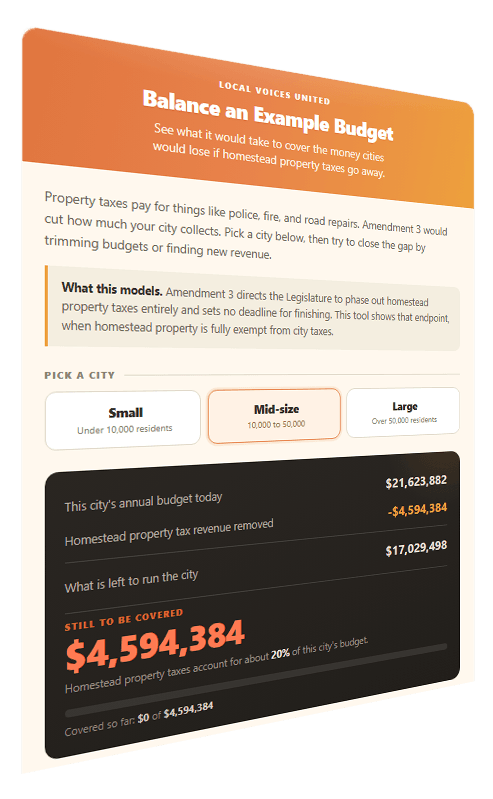
Try Your Hand at Balancing the Budget
Property taxes pay for things like police, fire, and road repairs. Amendment 3 would cut how much your city collects. Use our interactive budget balancing tool to see what it would take to cover the money that cities lose if homestead property taxes go away.
How Your Property Taxes Work
Property taxes are how your community funds the services people depend on. Law enforcement, fire and EMS, road repair, stormwater, parks. Unlike most other revenue, they're raised locally and stay local.
Your bill comes from two numbers:
- Your property's taxable value
- The millage rate
Your city, county, school board, and certain special districts each set their own rate every year, in public budget hearings anyone can attend.
Here's how a dollar breaks down statewide:
- Assessed Value – Set by the county appraiser based on market value.
- Exemptions – Homestead and other exemptions reduce your taxable value.
- Assessment Caps – Save Our Homes caps growth for full-time residents.
- Millage Rate – Chosen annually by your local government to meet community needs.
- Police and fire departments
- Street and sidewalk maintenance
- Waste and water services
- Parks and public spaces
- Neighborhood-based services
- Apply for exemptions like the homestead exemption.
- Review your assessed value — appeal if it's inaccurate.
- Attend public budget hearings and make your voice heard.

34.9 cents go to the county
$19,256,830,818

15.7 cents to the municipality
$8,671,955,841

38.9 cents to the school district
$21,481,626,417

10.5 cents to other & special districts
$5,765,564,310

Florida is one of the most tax-efficient states in the country.
SOURCE: WALLETHUB, MARCH 2025
Florida's average property tax rate is about half that of Texas.
SOURCE: TEXAS SCORE CARD, OCTOBER 2024
What Amendment 3 Actually Does
Amendment 3 is written to look like a straightforward cost-saving measure. But the full story is in the fine print.
If approved, Amendment 3 would:
- Raise the homestead exemption from $50,000 to $150,000 on non-school taxes, beginning January 1, 2027.
- Raise it again to $250,000 on January 1, 2028, then automatically increase that amount each year to keep pace with inflation.
- Constitutionally require the Legislature to set a schedule for fully eliminating homestead property taxes, with no deadline and no replacement revenue named.
- Make anyone establishing Florida residency after December 31, 2026 wait five years to qualify for the larger exemption.
What it leaves out is just as important:
- No replacement for the revenue it eliminates. The amendment doesn't say how critical services will be funded.
A Tax Shift. Not a Tax Cut.
Amendment 3 removes the largest source of local funding, but doesn't change what local services cost to run. It also doesn't say how that funding gap gets filled. Here's where it lands:
The exemption lowers one bill. Everything else goes up.
Public Safety Depends on Property Taxes
Statewide, more than 56% of city general-fund spending goes to police, fire, and EMS. In small cities, public safety alone runs about 90% of all property tax revenue.
In at least 85 Florida cities, spending on police, fire, and EMS already exceeds every property-tax dollar collected. In those places, public safety isn't part of the budget. It is the budget.
Florida firefighters have warned that cuts under this proposal could reach 25%. (CBS Miami, June 2, 2026)
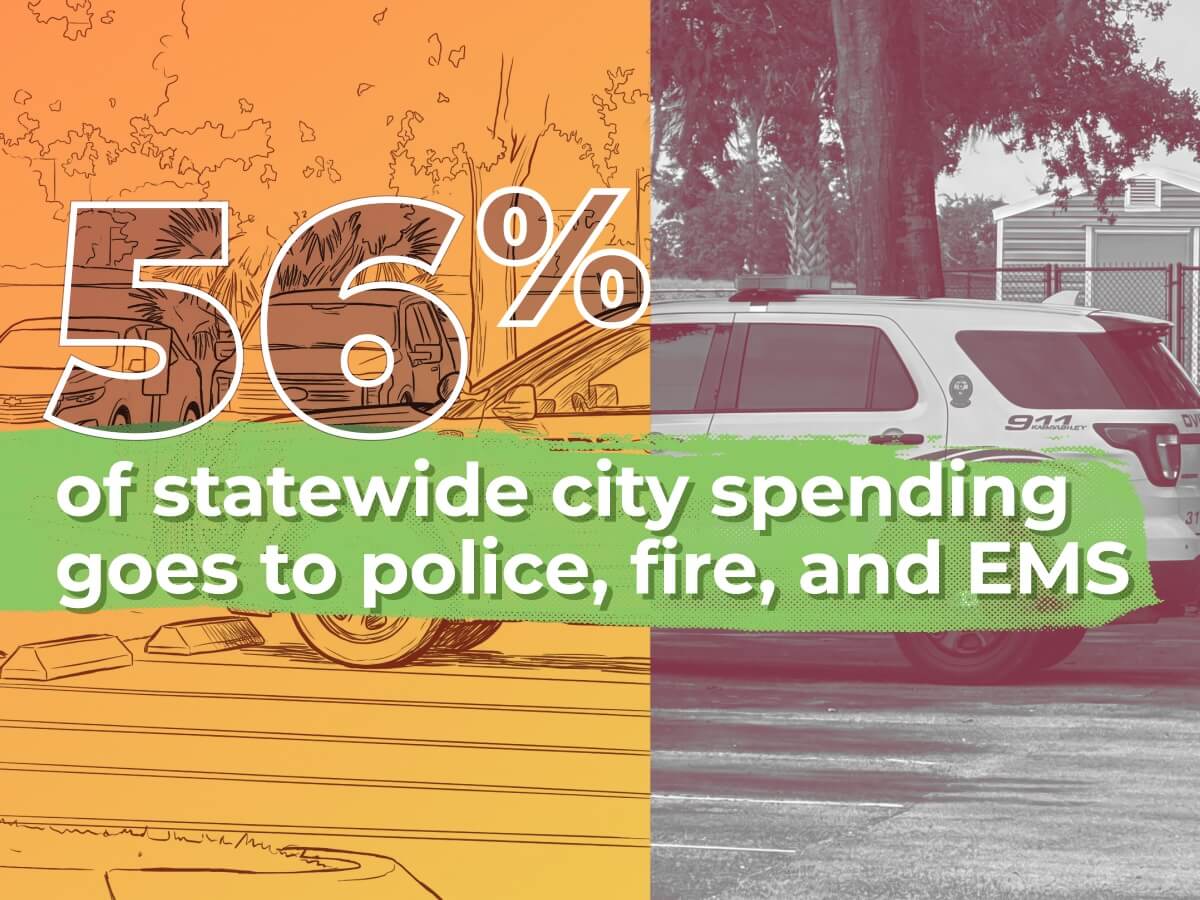
The amendment doesn't guarantee a single dollar for public safety.
Remove the money that pays for these services, and municipalities have no choice but to cut officers off the street and scale back the emergency response times that save lives.
Shifting Choices
From Your Town
to Tallahassee
Right now, the people who set your local tax rates live where you live. You can show up to their budget hearings. You can vote them out. That accountability is the whole point of local government, and it's exactly what Amendment 3 puts at risk.
By eliminating the main source of local funding with no replacement plan, Amendment 3 hands total control to Tallahassee. Decisions about what gets funded in your city, town, or village would be made by state politicians who don't live in your community and don't answer to you.
Communities would need to depend on the state to fund the basics. That's a move away from local self-government - and towards state dependency.
What works in Miami doesn't work in Monticello. A fast-growing metro, a rural town, an inland suburb, and a coastal community don't share the same needs or the same budget.
The people closest to a community are in the best position to decide what to fund and what they can afford. Amendment 3 replaces that judgment with a single statewide mandate, and then sends the bill back to everyone.
Amendment 3 will be on your November ballot. Don't vote on this without doing three things first:
Read the amendment, then read what the Legislature's own economists say it will cost: nearly $12 billion a year in funding for local services, gone.
See exactly what Amendment 3 would cost using this city-by-city data.
Pass it on. Most people will vote on this without ever seeing the math.
Amendment 3 adjusts the property tax exemption. It doesn't adjust what that exemption pays for. The cost of public safety, road repair, and emergency response doesn't disappear. It just stops being funded.
This November, vote on what you know, not just what's on the ballot.

Help spread the word.
You've seen the numbers. Now help your neighbors see them too.
We built a set of short, ready-to-post videos that break down what Amendment 3 really means for police, fire, and EMS funding. Download them, post them, share them anywhere.